The Darker Sides of Our Hospital Life
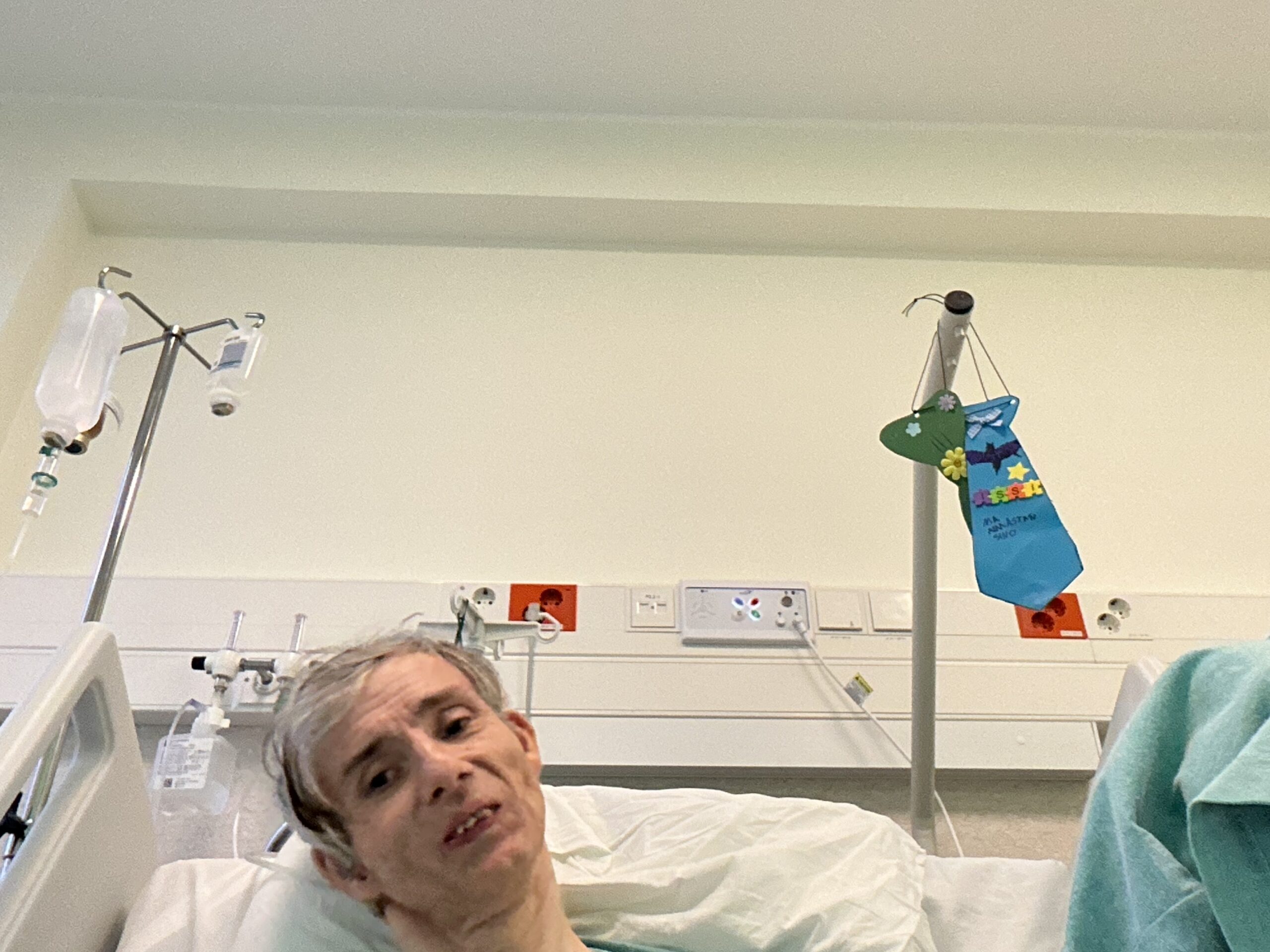
It so happened that at the end of October, our son developed a cough and high fever, which fortunately didn’t last long. It’s common for children to get sick—viruses are rampant in autumn. Anyway, I got sick next, and my situation wasn’t resolved so easily. One night, my fever rose above 38 degrees Celsius, and I started coughing. We managed to reduce the fever with paracetamol, but I ended up coughing heavily for the next few nights. On the third night, Mari called an ambulance. They didn’t do much for me. They wanted to take me to the emergency room, but since Lucas was sleeping and couldn’t be left alone at home, we postponed the hospital visit until morning. After Lucas was taken to kindergarten, Mari called the ambulance again. This time, it took us to West Tallinn Central Hospital. What happened next was very uncomfortable for me.
Considering my special needs—not being able to walk or speak—the next seven days were quite depressing. Treatment at the ER was actually quite humane. However, Mari wasn’t allowed to stay with me. Once the examinations were done and the diagnosis clear (bilateral pneumonia), I was transferred directly to a hospital ward. By the way, those examinations took about six hours. Of course, I had no contact with Mari—I didn’t have a mobile or an iPad with me. So, I lay there in great uncertainty and despair.
There was joy when I finally heard Mari’s voice outside the ward door, and she came with a suitcase to stay with me. But that’s not what happened. A nurse gave us a number and asked to call in the morning to arrange for a more private room.
Having been without food all day, I was able to alleviate my hunger with Mari’s help. She also brought the iPad to the hospital but left it charging next to the bed. So, she left me, hoping to be able to stay with me the next day.
The next day started just as dismally as the previous one. I waited in the morning for Mari to come and feed me because feeding me is not easy. But it didn’t happen, neither in the morning nor at lunchtime, as she simply wasn’t allowed to see me.
And I knew nothing about it because no one gave me the iPad from beside the bed, even though Mari had called and asked for it to be given to me. Of course, this happened sometime after lunch, but until then, I had been in total information isolation.
In the morning, I ate a bit of porridge-like salty “mush,” but it wasn’t edible at all. The same pattern repeated at lunchtime. Apparently, they somehow realized I was on a special diet. And, of course, the caregivers (mostly Russian-speaking) didn’t know how to feed me. To them, I was just object 4-4 (fourth ward, fourth bed). Some only spoke Russian—meaning they didn’t even attempt to speak the official language.
Since my attending physician was also Russian-speaking and didn’t speak English, Mari asked my sister to call him and explain the situation. Finally, Mari was allowed to come and feed me at lunch and dinner.
Thanks to my iPad, I was able to communicate a bit with the staff. Some caregivers walked around with a scowl, and there was no use trying to communicate with them. But yes—I would say it felt like a “Russian hospital.”
What made the experience even more uncomfortable was having to wear diapers, which were changed four times a day. The urination was a total ordeal for me, for some reason.
In terms of treatment, several bottles of painkillers and other stuff were administered intravenously every day—some by infusion, some by syringe. Additionally, my pain was managed orally as well. I don’t even know whether I was truly in pain or not because of all the medication.
The last evening in the hospital was quite unpleasant. Lucas had preschool on Mondays, so Mari couldn’t come to feed me that evening. She told several nurses at lunch, and they promised I would still get fed. But yes—when mealtime came, the caregivers just shrugged and didn’t want to feed me. One caregiver did try. I had a couple of spoonfuls, but one went straight down the throat (the food was potato with minced meat), and then I just didn’t want anymore—I didn’t risk it.
Oh, and they offered me that blender-made mush until I “told” them that I could eat regular food. On one occasion, the “mush” was particularly awful. I had Mari taste it, and her reaction was far from positive. I refused to eat it myself because the smell alone was alarming.
But the most important thing is that I got out of that hospital alive and relatively healthy. Nevertheless, I would not wish to return there. Seven days was too harrowing.