
A Ray of Light | Chapter Two
Our life at home was probably much like that of any ordinary family. At least, that is how I remember it. In our two-room flat on Mahlamäe Street, everyday life went on: there was growing up to do, and playing. I was a child who was given toys, cared for, and told off when he started having a tantrum.
And I certainly knew how to have a tantrum. Looking back, I think they happened quite often.
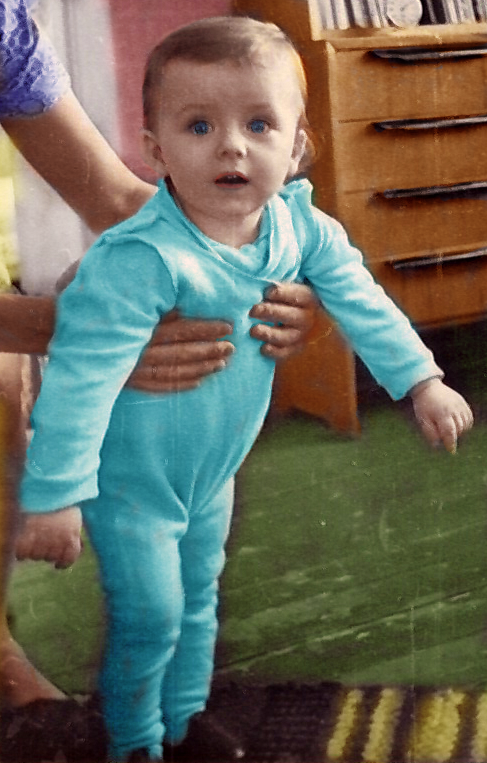
Even as a baby, I could straighten my legs and press my feet firmly against the ground. With mother holding me upright, I could be helped to walk.
My body needed more help and attention, but that did not mean I could have everything my own way. I, too, had to be told when something was not allowed or when my fussing had gone too far. I was treated like any other child, with all the affection and scolding that came with it.
I had a rocking horse. One that I could not fall out of. I can no longer describe every detail of its shape, but I remember being securely held in place.
There was also a red walking frame with wheels underneath. Attached to it was something like a pair of trousers, red with white spots, that I was put into. They kept me upright. That is how the frame remains in my memory, with its wheels and spotted trousers—a colourful little fragment of my early childhood.
Then there was a wooden high chair that could be converted into something resembling a little car. The tray stayed in front, and there were wheels underneath. The same object could be a high chair one moment and a little vehicle the next.
These things are clearer in my memory than the order of the days that passed around them. The rocking horse. The red frame. The wooden chair with wheels beneath it. Through them, the home of my early childhood comes a little closer.
My mother and father were there, along with my sister Ly and Grandma Ella. My people.
My parents were not ashamed of me. They took me everywhere, and I grew up knowing that my place was beside them. As a child, I saw nothing remarkable in that. It was simply how things were. Only later have I understood how much it meant to be included so naturally in family life.
But the falls continued.
One has stayed with me particularly clearly. I fell and struck my chin against the floor. Blood spattered. I was taken to hospital, where the wound was stitched.
My memory of that day is fragmentary, but certain moments remain: the fall, the blood, the stitching, and afterwards, my chin covered in plasters. I no longer remember everything in between. The scar, though, is still there—a small trace of a childhood day that might otherwise have faded long ago.
All the care and caution at home could not prevent every fall. My body still made involuntary movements, and my loved ones had to deal with the consequences again and again.
My dear parents kept looking for help.
After my stay in the Tallinn hospital, my condition had a name, but at home the questions remained. How could they help me? What could be done to support my physical development and make everyday life easier? We needed a doctor who could show us how to move forward.
My parents began to look towards Tartu with hope.
In our family’s experience, the doctors in Tartu understood my condition far better than those in the capital did at the time. One of the names my parents came across was Tiina Talvik. She was the doctor they wanted to take me to.
But access to a doctor also depended on where a child lived. As it was later explained to me, Rapla fell within Tallinn’s healthcare catchment area, which meant that the doctors in Rapla could not refer me to Tartu. My parents had found someone they hoped could help, but the usual route to an appointment was closed.
So they began making enquiries themselves, trying to find a way to contact Dr Talvik. Through private contacts, they managed to obtain her telephone number. I do not know who passed it on to them or how many people they had to ask. What remains in our family’s story is the result: they got the number, and eventually they got me to her.
That was how I came into the care of a doctor whom I still consider one of the best people I could possibly have reached at the time.
At the first appointment, my mother told her my story. She also told her what had happened in the Tallinn hospital.
Dr Talvik shook her head.
I cannot pass on her exact words. What remains is that shake of the head, and the help that followed. She immediately referred me to the children’s sanatorium hospital in Haapsalu, prescribed medication, and advised my parents on how to care for me from then on.
After so much searching, we finally had a next step.
That referral gave me access to proper treatment. Meeting Dr Talvik became a turning point in my life, the moment from which I slowly began to “get better”.
Or perhaps it would be more accurate to say: to develop.
Looking back, that word seems more precise. Getting better carries the hope that an illness will pass and that one day everything will be all right. With treatment, I began to make gradual progress in my development. It took time. I can no longer match every change to a particular appointment or course of treatment, but the sense of that turning point remains: after we reached Dr Talvik, things began to move in a better direction.
I needed her help again later, when a new kind of episode entered my life.
I do not remember exactly how old I was. Perhaps four or five. I began having what seemed like epileptic seizures. They happened just as I woke from sleep, at the very moment when sleep ended and ordinary wakefulness should have begun.
These episodes brought a new worry into our home.
My mother and father have loved the arts all their lives. They danced and sang, and my father was also a musician for many years. These activities were part of their lives and sometimes took them away from home in the evenings and at night.
Although my parents often took me along, there were occasions when Ly and I stayed at home on our own. Grandma Ella could not always come to look after us.
Ly was afraid of those evenings. She asked our parents not to leave the two of us alone.
She was four years older than me, but she was still only a child. I was her little brother, the one she had named and grown up alongside. Looking back now, I try to imagine what it must have meant for her to know that I might have another episode when I woke. There were only the two of us at home, and she was the older one. That alone may have placed a responsibility on her that no child feels ready to bear.
Her plea has stayed with me. As a child, I heard my sister’s fear in it. Now I understand more of its weight.
I remember one occasion when Grandma Ella was with me and had to get through another of my episodes too. I no longer have all the details. There is a fragment of memory of my grandmother and me, and the knowledge that it happened while I was in her care. She had looked after me so often, and now she had to be beside me through this as well.
It was thanks to Dr Talvik that I became free of those episodes. She prescribed a medicine that helped, and they stopped.
That is one change I remember clearly. My overall development was gradual, and its individual steps are difficult to distinguish after so many years. With these episodes, it was different: they had happened, they had frightened my loved ones, and treatment had freed me from them.
For that, too, I am grateful to her.
I went to see Dr Talvik in Tartu quite often until I reached adulthood. Those appointments accompanied me through childhood and adolescence. The child who first came to her had been small, with his mother speaking for him, and over the years she watched him grow.
We stayed in touch after I became an adult. We had a very good relationship, and later I wrote her emails, asked for advice, and wished her a happy birthday. I look back on this with gratitude: the doctor my parents had once tried so hard to reach had become a familiar person I could still turn to many years later.
When I look for a ray of light in that time, I always return to the first appointment. My mother spoke, and Dr Talvik listened. Then came the referral, the prescriptions, and the advice my parents could take home with them.
After months of my mother being told to wait, someone had shown us what could be done to help me.
Our next journey would take us to Haapsalu.
Thank you for reading my story so far. This will be the last chapter I publish here on the blog. The rest of the story will be waiting for you in a book one day. I cannot yet promise when—but the writing continues. I hope you will join me for the pages still to come!
