A School Placement Is Not Just a Question of Meters
The time has come when the youngest member of our family must start first grade this autumn and begin his journey in search of knowledge. He has already attended preschool for two academic years. First, he completed the preschool programme at Tallinn Secondary School of Science, and during the past academic year he attended the preschool programme at Tallinn English College.
Lucas can read and write in two languages, and arithmetic is not unfamiliar to him either — he manages well. An interesting fact is that he also writes quite well in English, even though his preschool learning took place in Estonian.
So, in the spring, we had to choose a school.
The nearest school to us is about 600 meters away — Tallinna Kunstigümnaasium. Since we communicate closely with other parents and live very near the school in a visual sense, we know that this school does not have the best reputation. It did not give us the feeling that we wanted our child to begin his school journey there.
Our choice was Tallinna Avatud Kool. We also marked this choice in the Education Department’s LAUR system. When submitting the application, it was stated that the parent’s preference would be taken into account where possible. We thought: alright, done.
But it turned out that things were not that simple.
We received a letter stating that our son had instead been assigned to Tallinna Kunstigümnaasium. On paper, it may seem logical: the nearest school is assigned as the child’s local school.
But in real life, a school placement is not only a question of meters.
I submitted an appeal to the Education Department, because my question was simple: if a parent’s preference is asked for and it is said that it will be taken into account where possible, then how was it actually considered? Why was our preferred school not taken into account, and why was our child assigned to a school we had not chosen?
The Education Department’s response was essentially that a parent’s preference is considered only where possible and that a parent has no subjective right to a specific school. I understand that. I am not claiming that every parent must automatically have the right to get a place for their child in exactly the school they want.
But if the parent’s preference is part of the application, it should not be merely a formal box to tick. It should be clear whether that preference was considered and why it could not be taken into account.
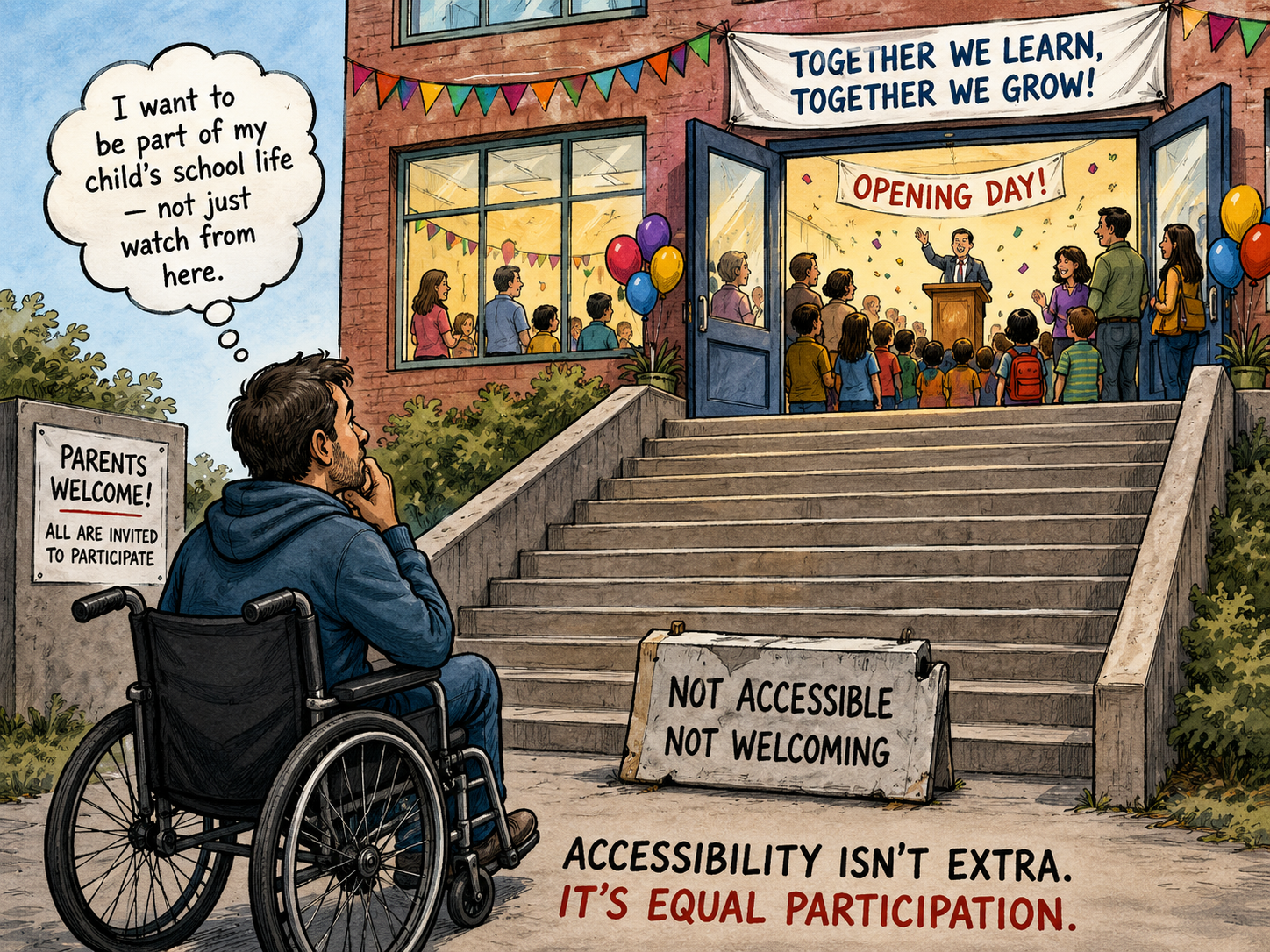
Meanwhile, another important fact came to light: Lucas Nikolas’s father — that is, me — cannot actually access Tallinna Kunstigümnaasium in a wheelchair, because there is no proper wheelchair access. There is, admittedly, a disabled lift inside the building, but that alone does not make the building accessible as a whole.
For this reason, I submitted a second appeal and focused specifically on accessibility.
This is something more than a school preference.
I am a wheelchair-using parent. For me, my child’s school is not just a place where my child goes in the morning. It is a place I also need to be able to access when necessary — for development meetings, parent meetings, meetings with teachers, school events, or to resolve issues related to my child.
A parent’s role does not end at the school door.
If a school is the closest one to home, but it is not truly accessible to a wheelchair-using parent, then it cannot be said that the decision has been made with the actual needs of the child and family in mind. Distance on a map does not always show real accessibility.
Accessibility is not a convenience. It is not a special request. It is a prerequisite for a disabled parent to be able to participate in their child’s school life on equal terms with other parents.
That is the central issue for me.
When school choice is discussed, people often talk about how far the school is from home. But much less is said about whether the parent can actually enter that school. Can they attend a meeting? Can they meet with the teacher? Can they move around the school building without unreasonable outside assistance? Can they be present for their child?
These are not secondary questions.
If a public service is meant for everyone, it must also be accessible to disabled people. A municipal school is not only a place of learning for children, but also part of a public service where parents have rights and responsibilities under the law.
My second appeal was forwarded to the Tallinn City Government, and it will be reviewed within 30 days.
I am not writing about this only because of one school placement.
I am writing because accessibility should not reach decision-making only when a person has to fight for it as a separate issue. It should be a natural part of how public services are organised.
If the city asks for a parent’s school preference, that preference must be genuinely considered.
If a parent uses a wheelchair, accessibility must be genuinely assessed.
If a school is assigned to a child, that solution must work not only on a map, but also in real life.
A child’s school journey does not begin only in the classroom. It begins with cooperation between home and school.
And in that cooperation, there must also be room for a parent who uses a wheelchair.