

LifeSimu – A Cozy 3D Multiplayer Island World
In today’s world, artificial intelligence brings excitement, big questions, and controversy all at once. For me, it has become above all a tool — a system that helps turn my ideas into working prototypes and real projects.
For some time now, I have been experimenting with programming across different platforms and learning step by step how to turn my thoughts into digital form. LifeSimu is one of the latest projects on that journey: a 3D multiplayer world set in a procedurally generated archipelago, where players can explore mountains, beaches, and underwater areas, meet other real players, and move together in the same world in real time.
The project is built with Three.js, TypeScript, and the Colyseus multiplayer server solution. During development, I use Claude Code, powered by the Claude Sonnet 5 model.
Artificial intelligence does not replace my ideas or decisions. Instead, it helps me test them more quickly, solve technical problems, and gradually turn my vision into a functioning world.
LifeSimu is not centred around fighting, defeating opponents, or climbing a leaderboard. Instead, it focuses on the landscape, movement, atmosphere, and the feeling that something is truly happening in the world.
An Archipelago Where You Can Climb, Swim, and Meet Other Players
LifeSimu is a cozy multiplayer world set on a procedurally generated archipelago. Mountain peaks rise above valleys, sandy beaches lead into shallow seas, and sharks, turtles, and other underwater creatures move beneath the surface.
Players can choose a character, climb mountain slopes, walk along the shoreline, or swim underwater. Everything happens in real time alongside other players in the same world.
Many multiplayer games begin with combat, competition, or a points system. LifeSimu starts from a different idea: first comes the world and the movement within it. Whether a character is climbing a mountain slope, walking on the beach, swimming underwater, or meeting other players along the way.
The game server controls the physics, movement, and player positions. This means that all players see the same world, while the movement of other characters remains as smooth and reliable as possible.
The client only renders what the server has already accepted as true.
From Mountain Peaks to the Shoreline
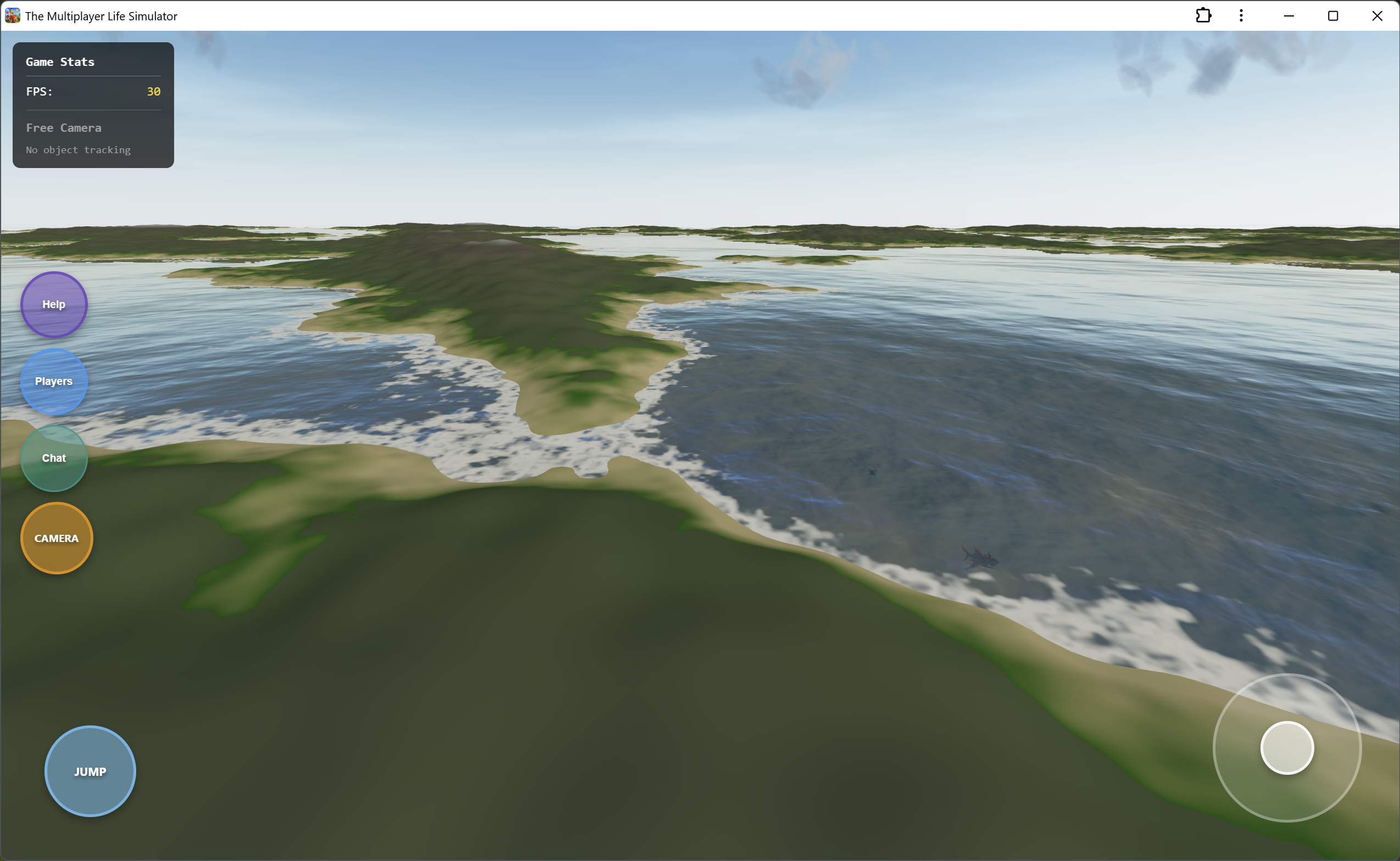
The LifeSimu world is approximately 3,000 × 3,000 units in size. It includes high mountain peaks, valleys, steep slopes, lower coastal areas, and an ocean.
The terrain is not manually drawn or built in advance. Instead, it is generated procedurally. This means that the shape of the archipelago, its elevations, and the different areas of land are created through rules. As a result, more natural-looking mountains, beaches, and lowlands can emerge.
The ocean is not simply a flat blue surface either. The movement of the water, lighting, sky, and clouds help create an atmosphere in which the shoreline and sea look slightly different at different moments.
The goal is not just a technical effect. The water, sky, shoreline, and mountains should work together to create a place where players enjoy simply moving around, exploring, and meeting others.
Characters with Real-Life Backgrounds
The LifeSimu world is not empty. In addition to players, NPCs also move around the world.
NPC stands for non-player character — a character not controlled by a real player. An NPC moves through the world according to its own rules, artificial intelligence, and animations. For example, it may walk, swim, search for a route, or simply move around the world on its own.
The characters in LifeSimu are not only part of a technical system. Many of them are connected to our real lives.
Playable characters:
- Mella – a character based on my own prototype, which also serves as one of the foundations for the game’s scale and physics;
- Lucas – a playable character based on my son;
- Gadgeteer – a playable character;
- Pinky – a playable character;
- Alien – a playable character.
NPCs and underwater creatures:
- Tom – an NPC based on our own cat, moving around on land;
- Turtle – a character based on our real turtle, only on a larger scale in the game world;
- Shark – an underwater NPC with its own movement logic;
- Octopus – an underwater creature created by Lucas himself in Meshy.ai.
Tom is a particularly interesting character because his movement logic has changed a great deal during development. In the beginning, his behaviour was simpler, but over time he has gained better pathfinding abilities.
This means that Tom must be able to move across terrain at different elevations, avoid areas that are too low, and find sensible routes between mountains, beaches, and higher ground.
Meshy.ai: From a Photo to a Game Character
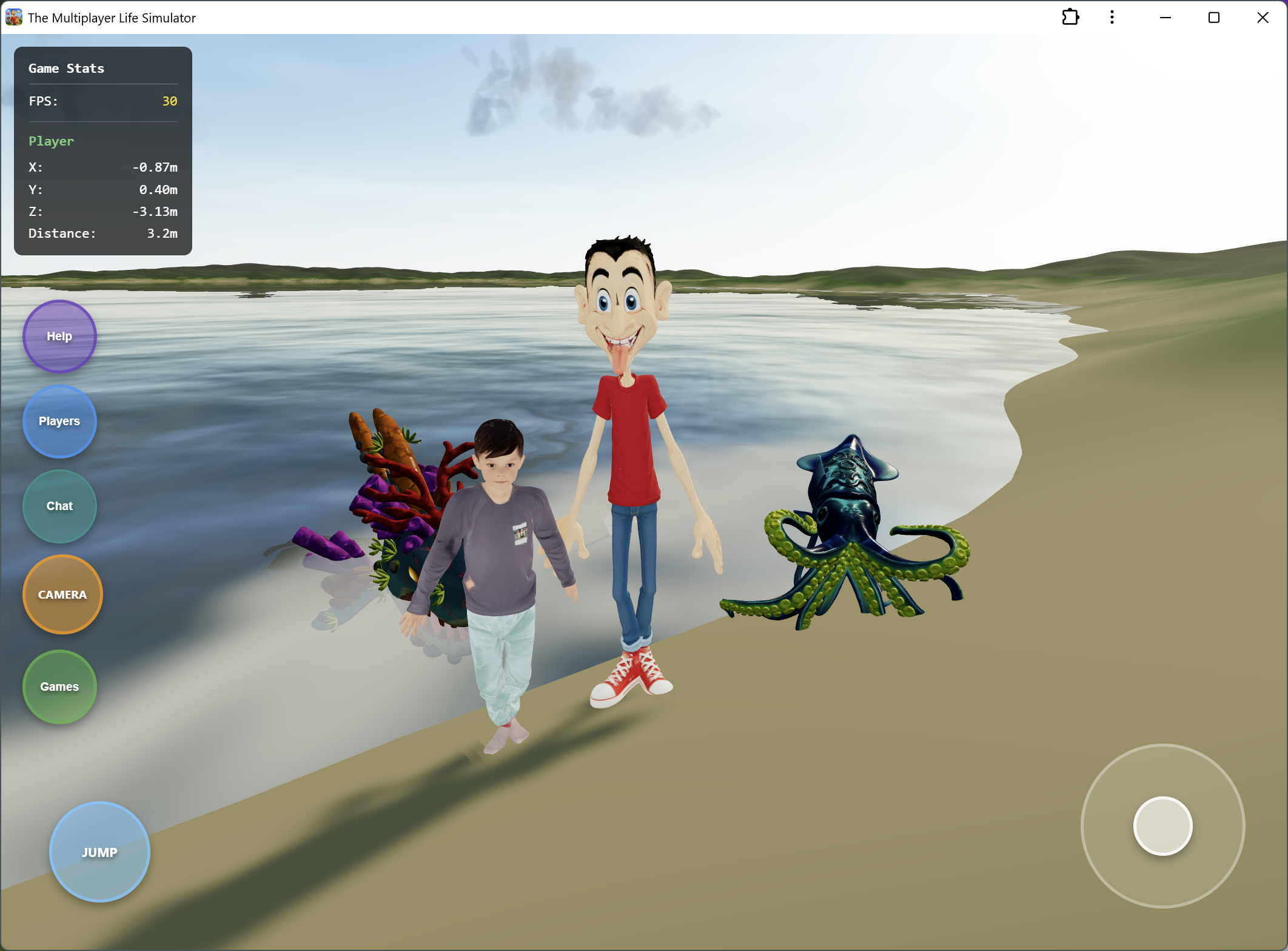
The 3D models in LifeSimu were created using Meshy.ai. It has made it possible to quickly turn an idea or a photograph into a 3D model that can be used in the game world.
With Meshy.ai, for example, a photo can be used as a starting point, turned into a 3D figure, and later given a skeleton and animations. This makes it possible to develop an ordinary image or idea into a character that can stand, walk, swim, or move independently in the game world.
This has been especially exciting with the LifeSimu characters. Mella is based on my own prototype, Lucas is connected to my son, Tom is our cat, and the turtle resembles our real turtle. The octopus-like underwater character is not simply a ready-made asset either, but a creature created by Lucas himself.
These details give the game its own personality. The LifeSimu world is not made up only of random models — it includes our own people, animals, ideas, and creativity.
Multiplayer Without War
The multiplayer side of LifeSimu is not about battles or defeating opponents. Its purpose is to create a social layer — the feeling that you are not alone in the world.
Each player has their own username. When entering the game, players can see a list of other players and communicate with them through a real-time chat system.
There is also a character reservation system. For example, when someone chooses Lucas, that character is reserved for a short period of time. This prevents two players from entering the world at the same time as exactly the same character.
At any moment, peaceful exploration of the world can turn into a small activity. One such mini-game is Star Game, where players search for stars scattered around the world.
The stars do not appear endlessly. The server keeps their number limited so that searching remains interesting even when more players are moving around in the same world at once.
Playable on a Phone Too
LifeSimu is built as a PWA, or Progressive Web App, which can also be used on a phone.
At the start of the game, a splash screen and preloader make sure that the necessary models, textures, and other assets are loaded before entering the world. Later, caching helps the game open more quickly.
Touch controls also make it possible to move around the LifeSimu world on a mobile device. This means that the game is not limited to a computer, mouse, and keyboard.
A Development Diary in Git History
The Git history clearly shows how LifeSimu has grown. It is not simply a list of technical changes, but a development story in which new layers have gradually been built on top of one another.
Foundation
Character swimming animations and improvements to multiplayer synchronisation. This was the first moment when water began to feel real in the game.
Ecosystem
New NPCs and notifications were added to the world. The archipelago became a place where more than just the player could move around.
Artificial Intelligence
The first steps of Tom’s AI. Simple movement grew into pathfinding that must work even when multiple players and NPCs are present in the world at the same time.
Character Selection
A character selection screen was added, along with the option to disable it during development or testing.
Visuals
Ocean waves were moved from a more calculation-heavy approach to a solution that relies more on the graphics card. The Alien character was added, and animations were improved.
Community
A real-time chat system was added, along with improvements to the user interface and mobile controls.
Refinement
Swimming-depth calculations became more accurate, a shark was added, and the rules for movement across terrain and underwater were refined.
Today
The follow camera and swimming behaviour have become more immersive. An automatic login option has also been added, making testing faster.
A Project That Grows Along with Me
LifeSimu is still at an early stage. The plan is to add more objects, more activities, and more mini-games like Star Game to the archipelago. I also want to experiment with many different ideas that could make the world feel more alive, playful, and interesting.
Development must be continuous. Every new character, object, animation, or game feature creates an opportunity to learn something and think further.
As the game develops, I develop with it. Creating a world like this requires a great deal of thought, experimentation, problem-solving, and the willingness to change earlier ideas. That is exactly what makes this project interesting to me.
LifeSimu is not only a technical experiment. It is a growing world that brings together my own ideas, my prototype, my son’s creativity, and the animals from our real life.
It is a world that keeps growing deeper, step by step — quite literally.

Try the game yourself!
Note! Regarding the gaming device, we cannot guarantee that this game will run smoothly on every computer/smart device, as it involves 3D technology.
