
Something is Different | Chapter One
When my mother brought me home from Rapla Hospital, there seemed to be nothing unusual about me. I was like any other baby: I slept, ate, cried, and needed care. The danger of those first days of life seemed to have passed. No one had told my mother that what had happened might have left a lasting mark.
We lived on Mahlamäe Street in Rapla, in a two-room flat in a typical Soviet-era apartment block. Those two rooms held our everyday family life, the activities of my four-year-old sister Ly, and now the work of caring for me. It was Ly who gave me my name. I do not know how she chose it, but it was my sister who named me Meelis.
My dear paternal grandmother Ella also looked after me. Her real name was Elviine, but in my story she is Ella. She was one of the loved ones I could be entrusted to, someone who cared for me throughout my childhood, until the summer of 1985.
Most of what I know about those first weeks at home comes from other people’s accounts. When I try to picture that time, I think of our two-room flat and the people around me. Caring for a baby fits in between everything else: the child needs to be picked up, fed, changed, and put to sleep. Life at home went on, and at first there was no reason to think anything was seriously wrong with me.
Yet somehow the hospital remained part of our lives. The staff often asked after me. They wanted to know how I was doing and how I was developing—more often than my family felt was usual with other children.
At first, this may have seemed like kindness. Only later did the question arise of whether there had also been some concern behind that attention, something my parents had not been told. I do not know what the hospital staff actually knew or thought. We were left with the understanding that I was healthy.
Gradually, however, my mother began to notice that some of the expected skills were not emerging. Other babies my age were learning to hold their heads up and roll over. I was not beginning to do those things.
My mother still remembered Ly’s development clearly. She saw me every day and noticed differences that were becoming harder to dismiss. When she asked the doctors, they reassured her: some children simply start rolling over later; some need more time. Children develop at different rates.
There was reason to believe that answer, and probably a wish to believe it too. My mother had noticed something that worried her, but the doctor assured her that it did not necessarily mean anything was wrong. And so each new week could bring fresh hope that I, too, would begin to hold my head more steadily or turn onto my side.
I was not referred to a paediatric neurologist. Later, my family found this difficult to understand, because as far as they knew, other babies were being sent for such examinations. In my case, the waiting continued.
For almost nine months, our family lived with the understanding that I simply needed more time.
When I was placed in a sitting position, soft cushions were arranged around me. I could stay seated. To someone watching, everything might seem fine for a while: a child sitting there, with cushions around him just in case.
Then came the sudden movement.
My arms drew across my chest, and I fell. I had not chosen to move them that way, nor did I know how to stop myself from falling. Only later did my family learn that these involuntary movements were caused by cerebral palsy.
A fall could come in the middle of sitting quietly. One moment I was still; the next, my arms were crossed over my chest and my body was already tipping sideways. The cushions were supposed to catch me. When they were in place, I landed among them. But sometimes they had slipped away from me. Where there should have been something soft to break my fall, there was a gap.
Then my head struck the floor.
Miraculously, I still have fragments of memory from those falls. They do not show the whole room or a clear sequence of events. There are only isolated moments: sitting, my arms drawing across my chest, and falling. Then crying, and my mother or Grandma Ella lifting me into her arms.
I also remember something cold against the place I had hurt. It may have been a knife, its cool metal laid flat against my forehead. The object itself is not quite clear in my memory, but the cold touch is. After the fall comes being lifted, the closeness of someone familiar, and that coolness against the aching spot.
I always fell to the same side. A lump formed in the same place on my forehead. Before it had properly gone down, another fall could strike that very spot again.
When my mother and Grandma Ella looked after me, they had to keep in mind that a spell of quiet sitting could end without warning. They would pick up the crying child and try to cool the place where I had hurt myself. Later, the cushions would be put back in position. At home, they helped me with whatever was at hand, but the involuntary movements that caused the falls remained.
With every fall, the doctors’ assurances that some children simply developed later became harder to believe.
After yet another fall, my mother began insisting that I be examined more thoroughly. She was no longer willing to wait. She had to fight to get me a place in a hospital in Tallinn.
At last, a place was found.
I was about nine months old when I was taken into hospital. My mother did not stay with me. Our home on Mahlamäe Street and the familiar people around me were left behind, and I had to be entrusted to strangers for an entire month.
From that month in hospital, I may have one memory left: being weighed.
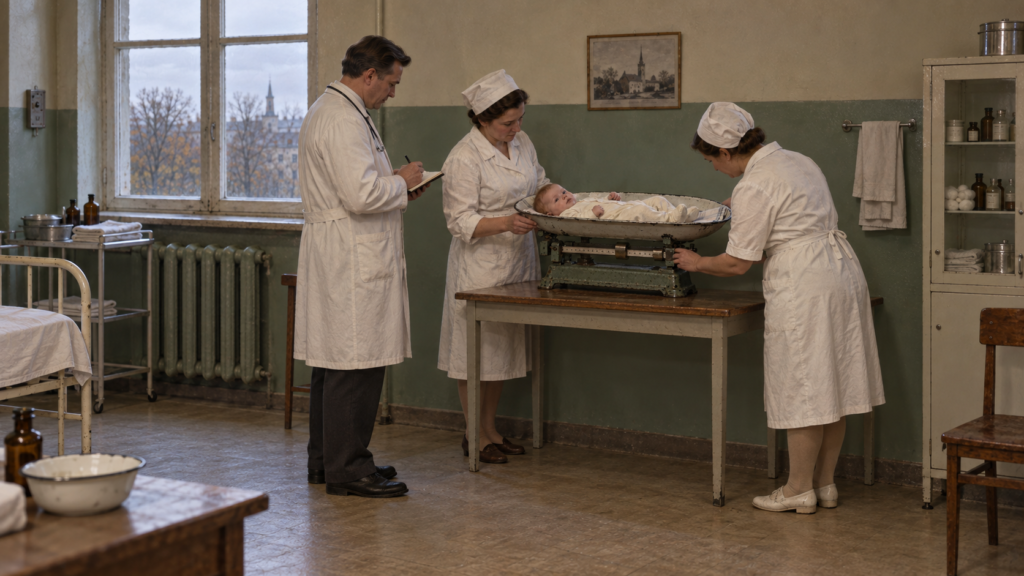
The scales were made of iron. On top was an oval, bowl-shaped tray in which the baby was placed. Beneath it sat the mechanical weighing mechanism. In my mind, those two parts still belong together: above, a hollow shaped to hold a child; below, the heavy mechanism that showed the child’s weight.
I have the impression that I was lifted onto those scales quite often. Somehow, it is the sense of repetition that remains—the same object, the same weighing. I do not remember the number on the scales or the person who read it. The scales themselves are clearer than anything around them.
I cannot say for certain whether this is an early memory of my own. Yet something feels familiar as I describe their shape. The rest of that month in hospital is almost blank, but out of that blankness emerges the oval iron tray.
I do not know whether a cloth was spread over it, what I heard while I was being weighed, or how I was picked up afterwards. I do not have those details. There is only a possible memory of something done to me repeatedly, at a time when I could not understand what it meant.
In hospital, it finally became clear why my movement skills were not developing like those of other children, and why my body made movements I could not control. The part of the brain that controls movement had been damaged—the motor centre, as it was explained to us. My condition had a name: cerebral palsy.
Until then, my family had been told that I needed more time. Now they learned that my difficulties had a cause that waiting would not remove.
In the years since, I have often wondered what an earlier diagnosis might have changed. If the damage had been identified in the days after my birth, and appropriate treatment and rehabilitation had begun as early as possible, perhaps my situation would be better today. Perhaps I could walk and talk like any other ordinary person. Who can know, looking back?
The developing brain has the ability to adapt and reorganise its connections. Undamaged areas can, to some extent, help take over the functions of damaged regions, and early rehabilitation can support that development. I cannot know how much it would have helped me, or what help was available at the time. But it is hard to accept that months passed amid reassuring explanations, while at home my mother saw more and more reasons to worry.
When my parents came to collect me a month later, I was wearing several layers of nappies. They were full. On my feet were the very same socks I had been wearing when I arrived.
The cuffs had dug into my skin, leaving red rings around my legs. I imagine that must have been deeply uncomfortable for such a small child.
I do not know what my mother and father said when they saw this. I have no words of theirs to pass on. What remains are those details: the nappies, the socks, and the marks on my skin. My parents had left me in hospital so that my condition could be investigated and I could be helped. When they returned, they also had to face the evidence of how I had been cared for.
Before going into hospital, I had been able to use the potty when someone sat me on it. In hospital, that ability had been lost. I do not know whether or how they put me on the potty there. My family noticed the change after I came home.
I had no way of explaining to them what had happened during that month. My parents could only go by what they saw for themselves.
At last, my family had an answer to why I had involuntary movements, why I did not roll over, and why I would suddenly fall while sitting. That knowledge had come after months of reassurance.
Now I had to be taken home, back to the two-room flat on Mahlamäe Street, where Ly and Grandma Ella were. My socks had to be taken off, I had to be washed clean and held in familiar arms again. Caring for me at home continued, but we could no longer hope that everything would resolve itself if we simply waited.
