
Half past twelve | Prologue
I was born at Rapla Hospital on 21 February 1968, at half past twelve in the afternoon.
It was a Wednesday. Estonia was then known as the Estonian Soviet Socialist Republic. Rapla was a small district centre, while Tallinn lay a little over fifty kilometres away. On an ordinary day, it was not a great distance. On the second day of my life, it became a fateful one.
I have no memory of my birth. I have pieced this story together from facts and fragments told to me later. I do not know whether it snowed that February day, who first touched me, or what my mother was told after the delivery.
I know only the most important fact: there was nothing wrong with me when I was born.
I breathed, cried and moved my arms and legs. There was no reason to believe that my life would be any different from that of other children.
Rapla Hospital was a modest Soviet district hospital. Worn linoleum covered the corridor floors, and the lower halves of the walls were coated in glossy oil paint. The air carried a mixture of sharp disinfectant, damp boiled linen, medicine and food drifting in from the hospital kitchen.
Nurses moved between the wards in white uniforms, their hair tucked beneath caps. Medical equipment was made of metal and glass. Syringes and instruments were washed, boiled and used again. A rotary telephone rang in the corridor, metal trays clattered, and heavy doors closed with muffled thuds.
Everything appeared to be in its proper place. Yet at the moment it was needed most, something essential could be missing.
After the birth, I was washed, weighed and wrapped in the hospital’s white linen. My details were written by hand on paper: 21 February 1968, 12:30 p.m.
My mother could finally breathe more easily. She already had a four-year-old daughter, my sister Ly. Now a second child had been born into the family.
In Soviet maternity hospitals, newborn babies were often kept separately from their mothers and brought to them only at fixed feeding times. I probably spent my first afternoon and night in such a nursery, lying in a small cot beside other babies tightly wrapped in linen.
The February day ended early. Darkness settled outside the windows, and dim lights were switched on in the wards. The hospital grew quieter during the night, but the footsteps of the nurse on duty and the opening of doors could still be heard in the corridors.
The following day, someone noticed that my skin had begun to turn yellow.
I do not know who saw it first. Perhaps a nurse noticed the change when she lifted me towards the window to examine me in daylight. She may have looked at my face and the whites of my eyes, gently pressed a finger against my forehead, and then called for a doctor.
A blood sample was taken. The glass tube was labelled and carried to the laboratory.
At first, my mother knew nothing. She remained in another ward, waiting for her baby to be brought back to her. Perhaps she was told only that I needed to be examined or kept under observation. In hospitals of that era, doctors decided how much a patient needed to know. My mother’s role was to trust them and wait.
The tests showed that this was not ordinary newborn jaundice. There was a Rhesus incompatibility between my mother’s blood and mine. Antibodies produced by her body were destroying my red blood cells, releasing bilirubin into my bloodstream. At dangerously high levels, bilirubin could damage the brain.
I urgently needed an exchange transfusion.
That required compatible donor blood, but Rapla Hospital did not have any. It had to be brought from Tallinn.
The hospital, however, had no car available to collect it.
This is the most difficult part of the story to comprehend. The necessary treatment was known and the blood existed, but there was no vehicle to bring it to Rapla in time. My life came to depend not only on doctors and medicine, but on a car.
Somewhere in the hospital, a telephone receiver was lifted. The numbers were dialled one by one, the rotary dial clicking back into place after each turn. Presumably, someone searched for a vehicle, a driver and an institution authorised to send them. I do not know the exact sequence of events.
In the Soviet system, everything supposedly belonged to the state. Yet at the moment of need, the necessary resource could be in the wrong place, assigned to another institution or inaccessible because no one present had the authority to release it immediately.
Meanwhile, the ordinary work of the hospital continued. Medicines and meals were distributed, floors were washed and medical records completed. My mother waited in her ward. No one told her that my brain might be in danger or explained what each passing hour could mean.
I was one day old and unable to tell anyone what was happening inside my body. My yellowing skin was the only visible warning.
Eventually, transport was found and the blood arrived in Rapla from Tallinn. I do not know who brought it, what kind of car they drove or how long the journey took.
Then the exchange transfusion began.
I was taken into a treatment room where my mother was not allowed to follow. The door closed. Small amounts of my blood were removed and replaced with compatible donor blood. The medical staff monitored my breathing and heartbeat while recording the details of the procedure by hand.
A nurse assisting with the transfusion carried a container of my removed blood out of the room.
My mother did not see it. She was still in her ward, unaware of what was happening on the other side of the closed door.
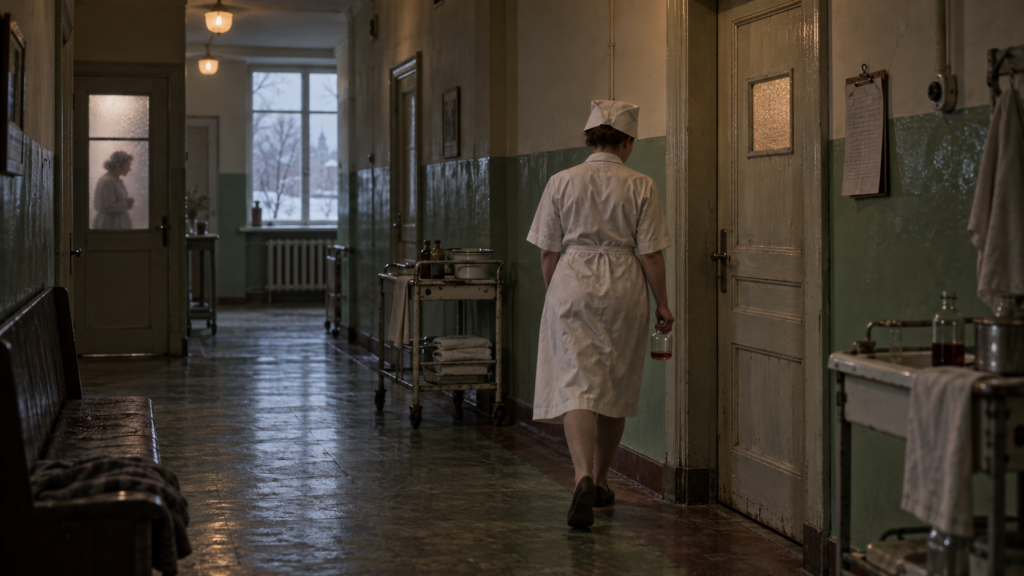
I was later told that hardly any red blood cells could be seen in the blood that had been removed. I do not know who witnessed it at the time or through whom the story eventually reached me. In my imagination, it has become a single dark image: a nurse walking along the dim hospital corridor, carrying a container filled with unnaturally pale blood taken from my body.
Her footsteps echo against the worn linoleum. Behind one door, people are trying to save a newborn child. Behind another, a mother waits without knowing how serious the situation has become.
The exchange transfusion saved my life. My bilirubin level fell and the yellow colour of my skin began to fade. From the outside, it may have appeared that the worst was over.
But the blood had arrived too late.
By then, the area of my brain responsible for controlling movement had been damaged. There was no visible wound. My arms and legs were intact, and my heart continued to beat. The effects of the damage would only become apparent later, when other children began to hold up their heads, sit, stand, walk and speak.
At first, my mother was not told that anything might have gone wrong. Perhaps the doctors did not yet know the extent of the damage. Perhaps they suspected the danger but did not want to discuss it. Their silence may also have reflected the medical culture of the time: the doctor decided, the staff acted, and the patient was told only what was considered necessary.
My mother was therefore left believing that the treatment had been completed and the danger had passed. Her child was alive and the yellow colour was fading. At home, four-year-old Ly and the rest of the family were waiting for us to return.
Only in the months and years that followed did it become clear that those first days in the hospital had changed my life permanently.
The hardest thing to accept is that I was not born this way. At half past twelve on 21 February, I entered the world as a healthy child. The following day, I turned yellow. The blood that could have helped me was available in Tallinn, but Rapla Hospital had no car to collect it in time.
Adults searched for transport and made telephone calls. My mother waited without knowing the truth. The hospital clock continued to tick.
My first victory was survival.
